Home · Sights · Santa Maria del Mar
Santa Maria del Mar: the people's Gothic church
What you are looking at
La Ribera · Ciutat Vella
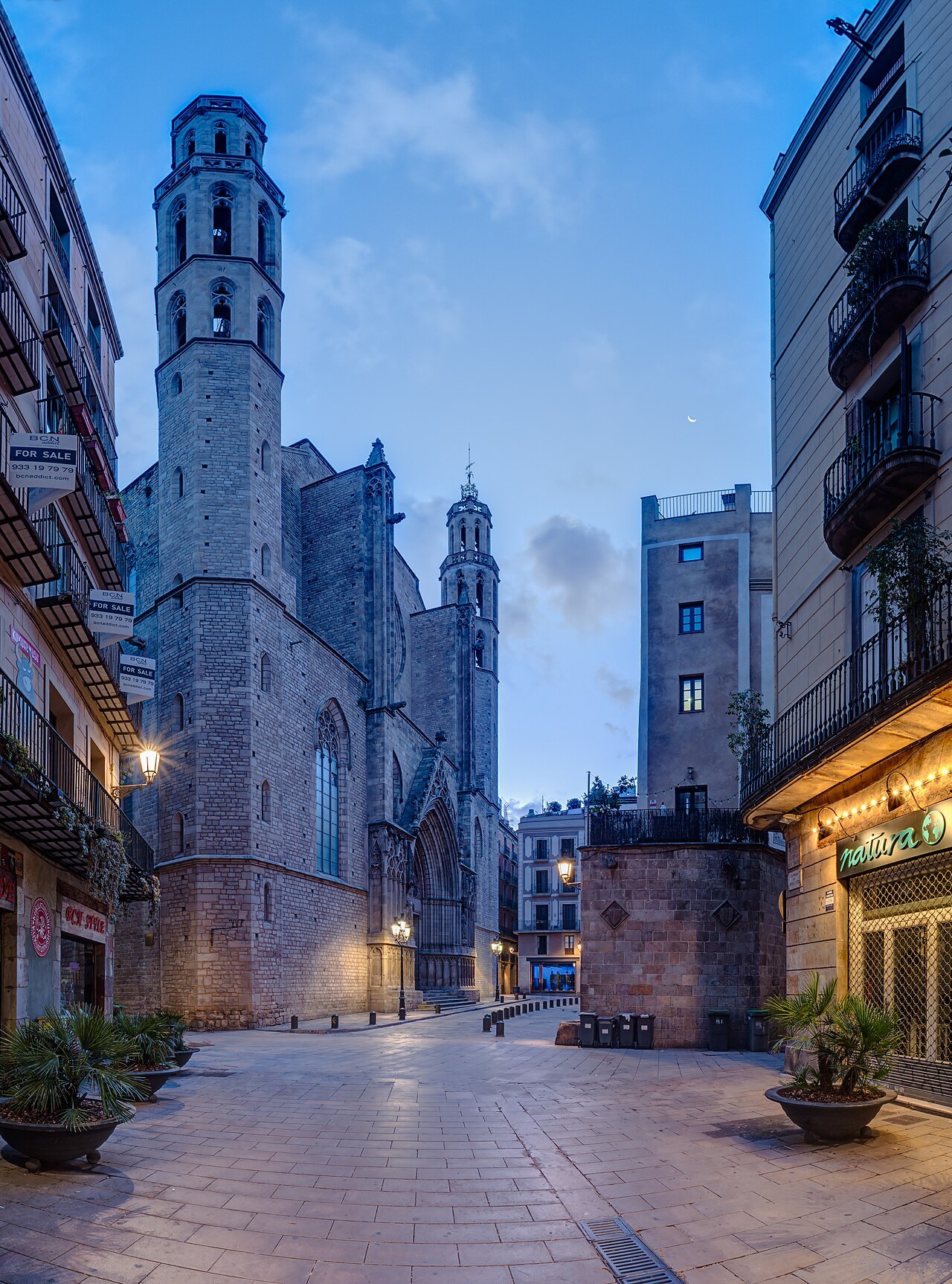
- 1The wide naveSlender octagonal columns spaced wider than in any other Gothic church in Europe.
- 2The rose windowA Flamboyant rose window of the 1450s that replaced one destroyed by the 1428 earthquake.
- 3The unified planThree aisles forming a single space, with no transepts and no boundary between nave and presbytery.
- 4The Fossar de les MoreresThe former burial ground beside the apse.
- 5The proportionsA design in medieval feet, one hundred feet wide and one hundred feet high.
Reading the place
The sight in full
A church backed by the people
The first mention of a church of Santa Maria by the sea dates from 998. The building you see was promoted by the canon Bernat Llull, appointed archdean of Santa Maria in 1324, and one of its distinctive features was its backing by the common people, as opposed to the nobility. The foundation stone was laid on 25 March 1329 by King Alfonso IV of Aragon, as a tablet in Latin and Catalan on the facade facing the Fossar de les Moreres records.
The architects were Berenguer de Montagut, who designed the building, and Ramon Despuig, and all the guilds of the Ribera quarter were involved in construction. The walls, side chapels and facades were finished by 1350. A fire in 1379 damaged important parts of the work, the last stone was laid on 3 November 1383, and the church was consecrated on 15 August 1384.
Pride of a seagoing city
The church was built at the height of the maritime and mercantile preeminence of the Principality of Catalonia, and the neighborhood around it was where merchants and port workers lived. Its name, Saint Mary of the Sea, fits a district oriented toward the harbor.
The novel La catedral del mar by Ildefonso Falcones, published in 2006 and adapted as a Netflix series in 2018, takes the construction of Santa Maria del Mar as its background, and has made the church known to many readers who have never been to Barcelona.
The exterior
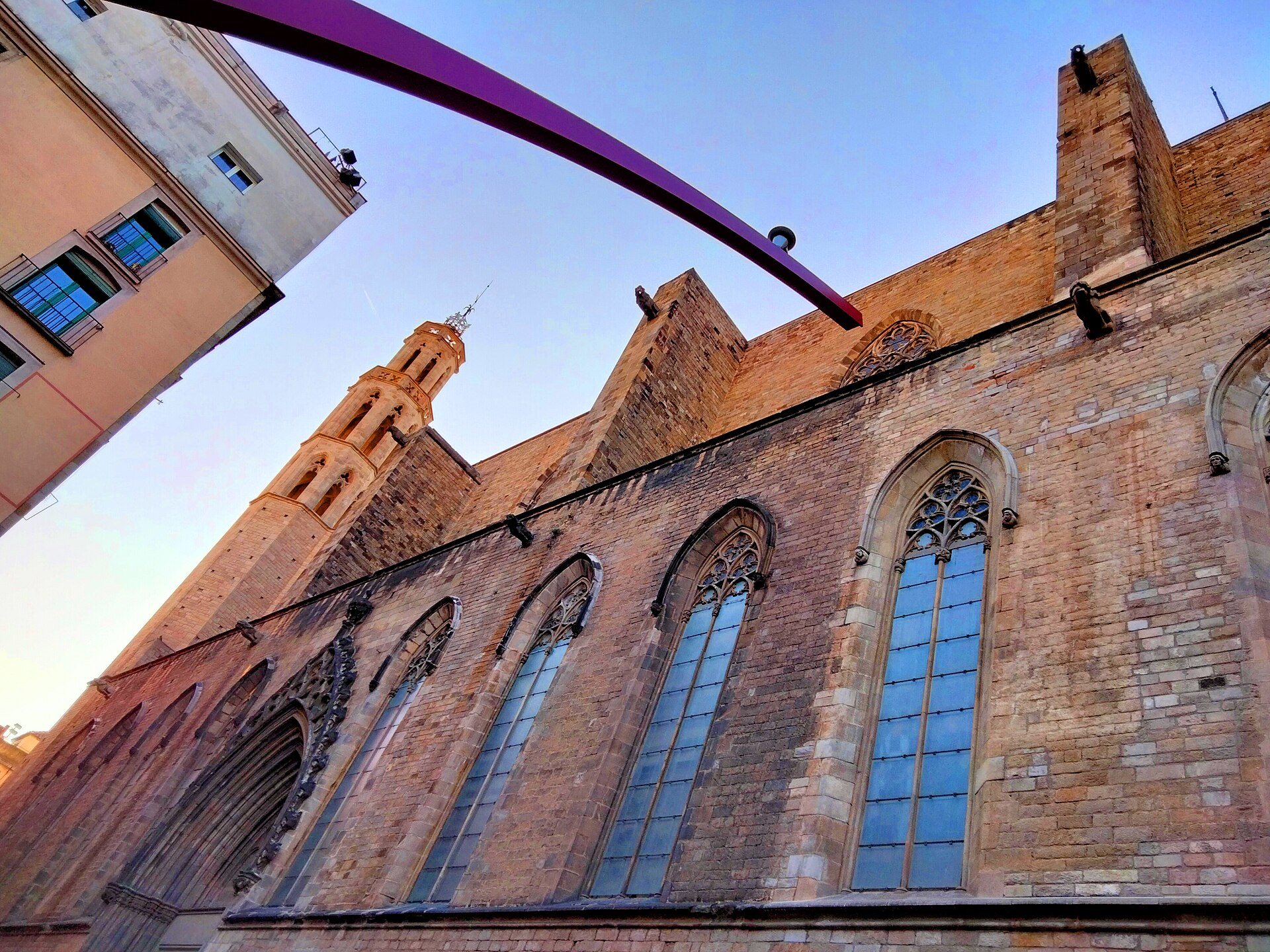
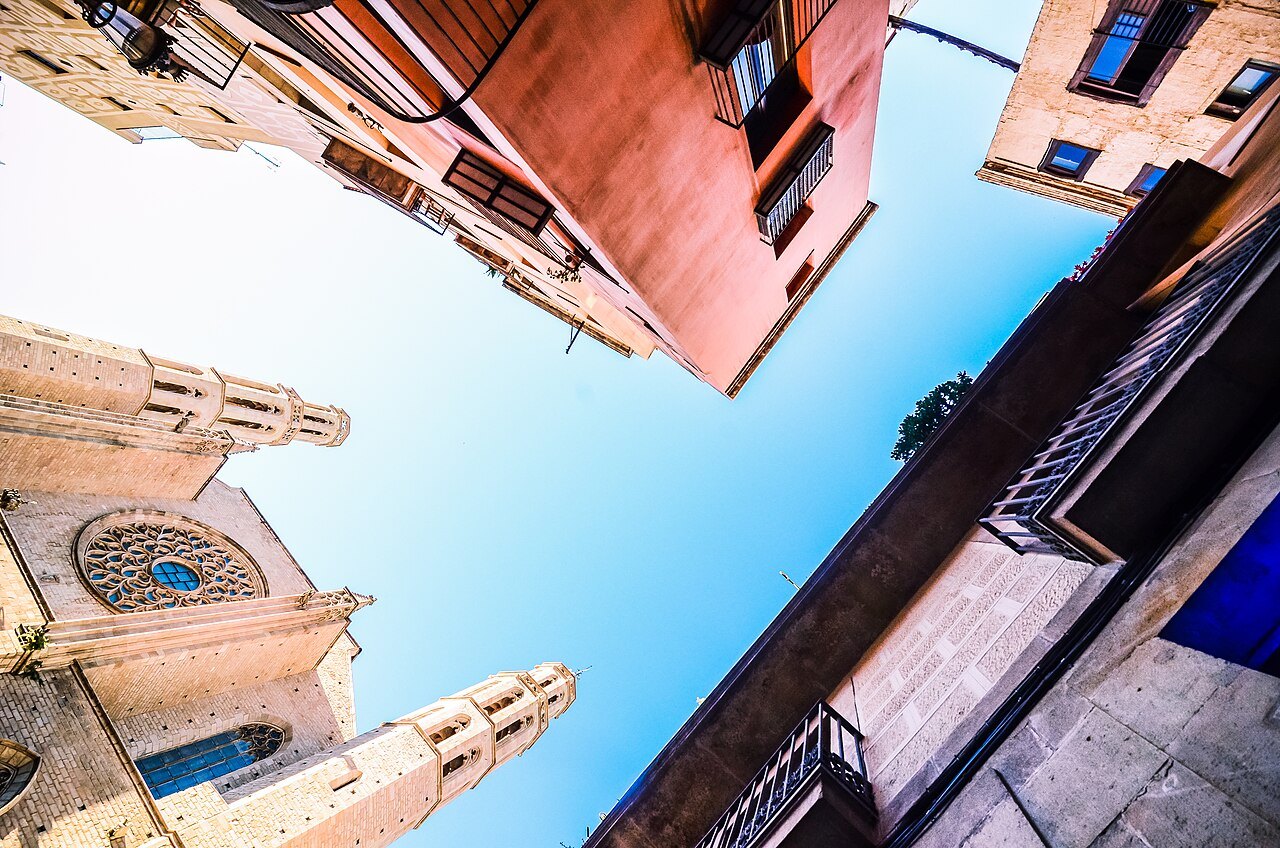
From the outside, Santa Maria gives an impression of massive severity that belies the interior. It is hemmed in by the narrow streets of the Ribera, which makes an overall view difficult, except from the Fossar de les Moreres and the Plaça de Santa Maria, both former burial grounds.
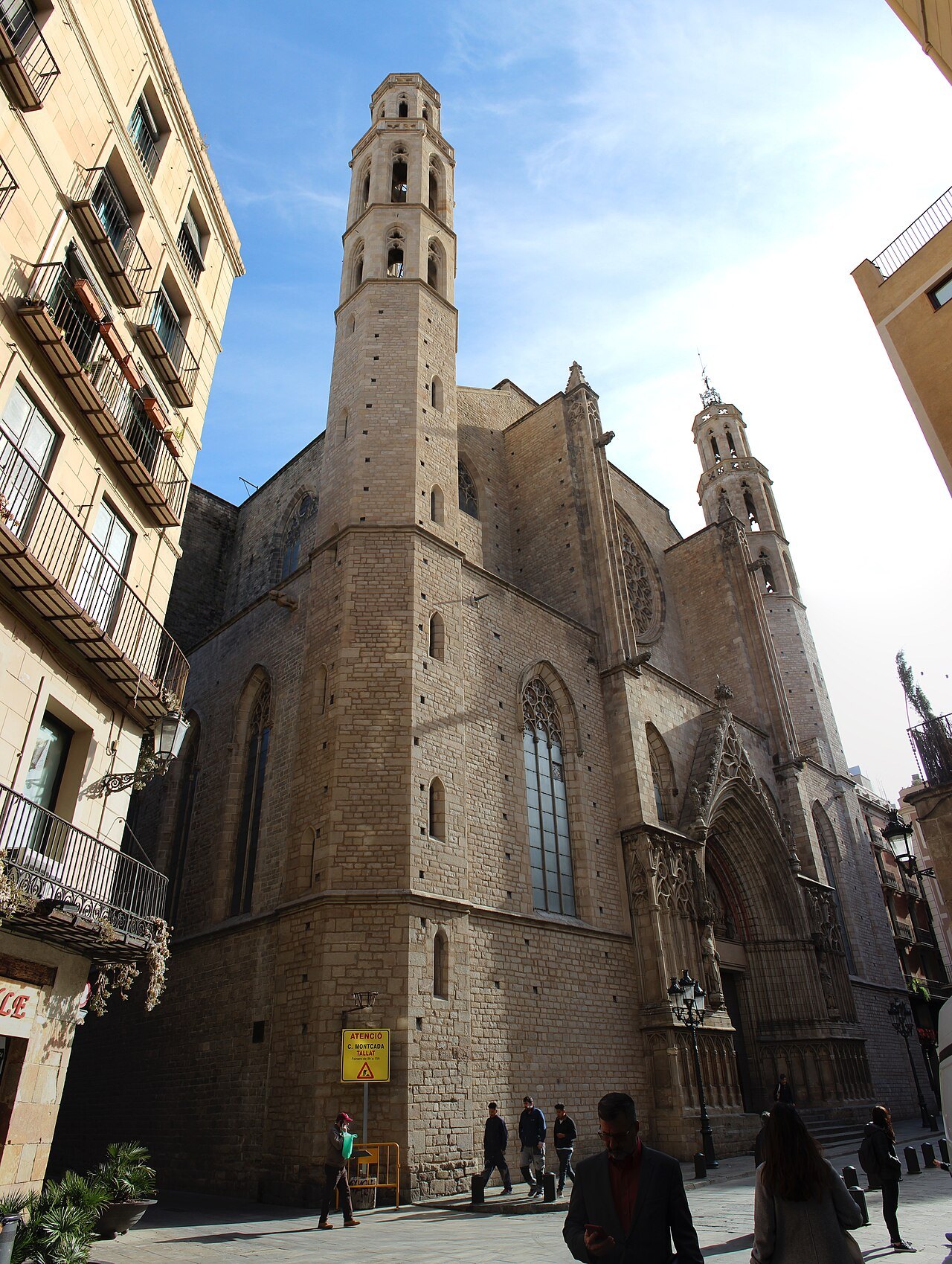
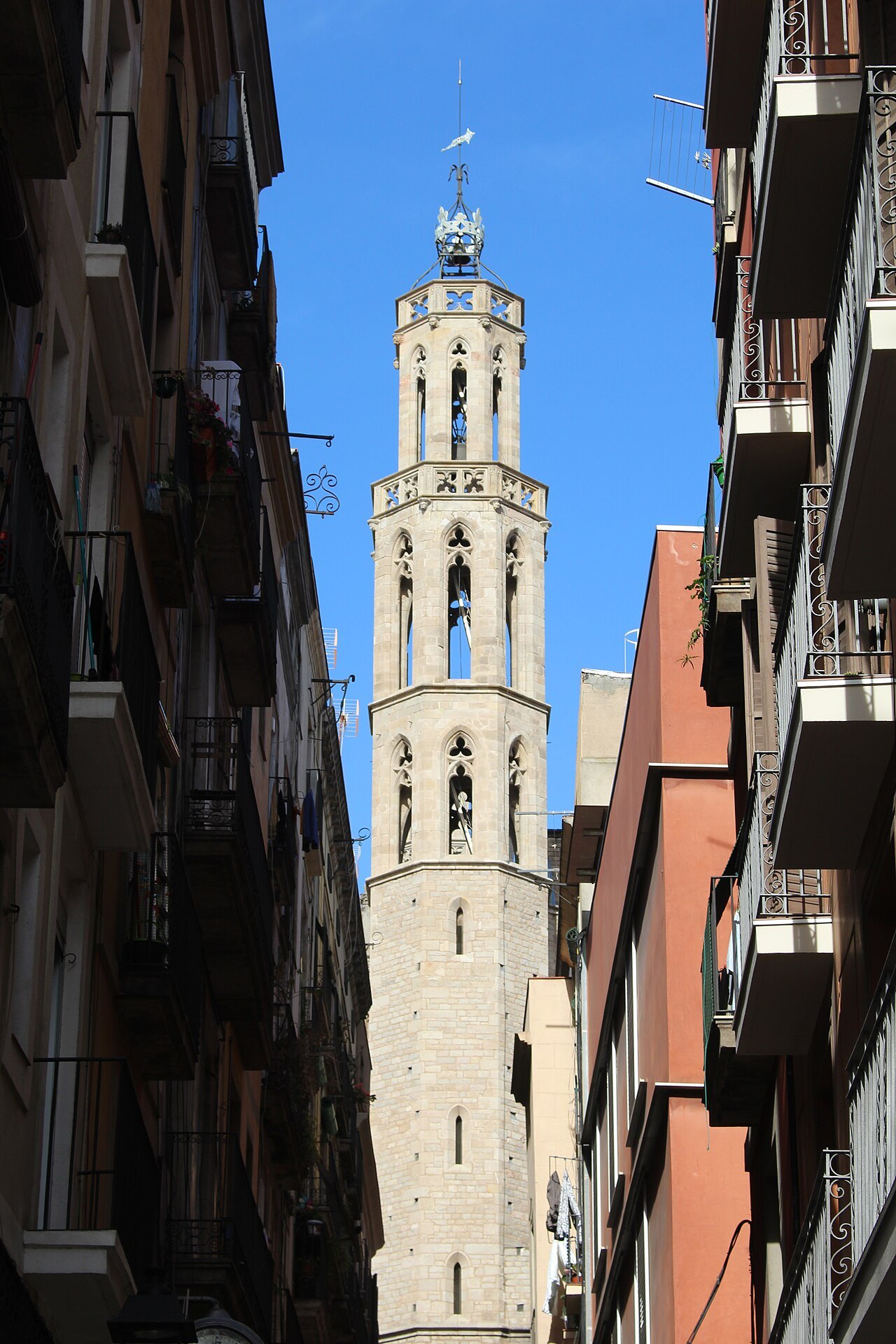
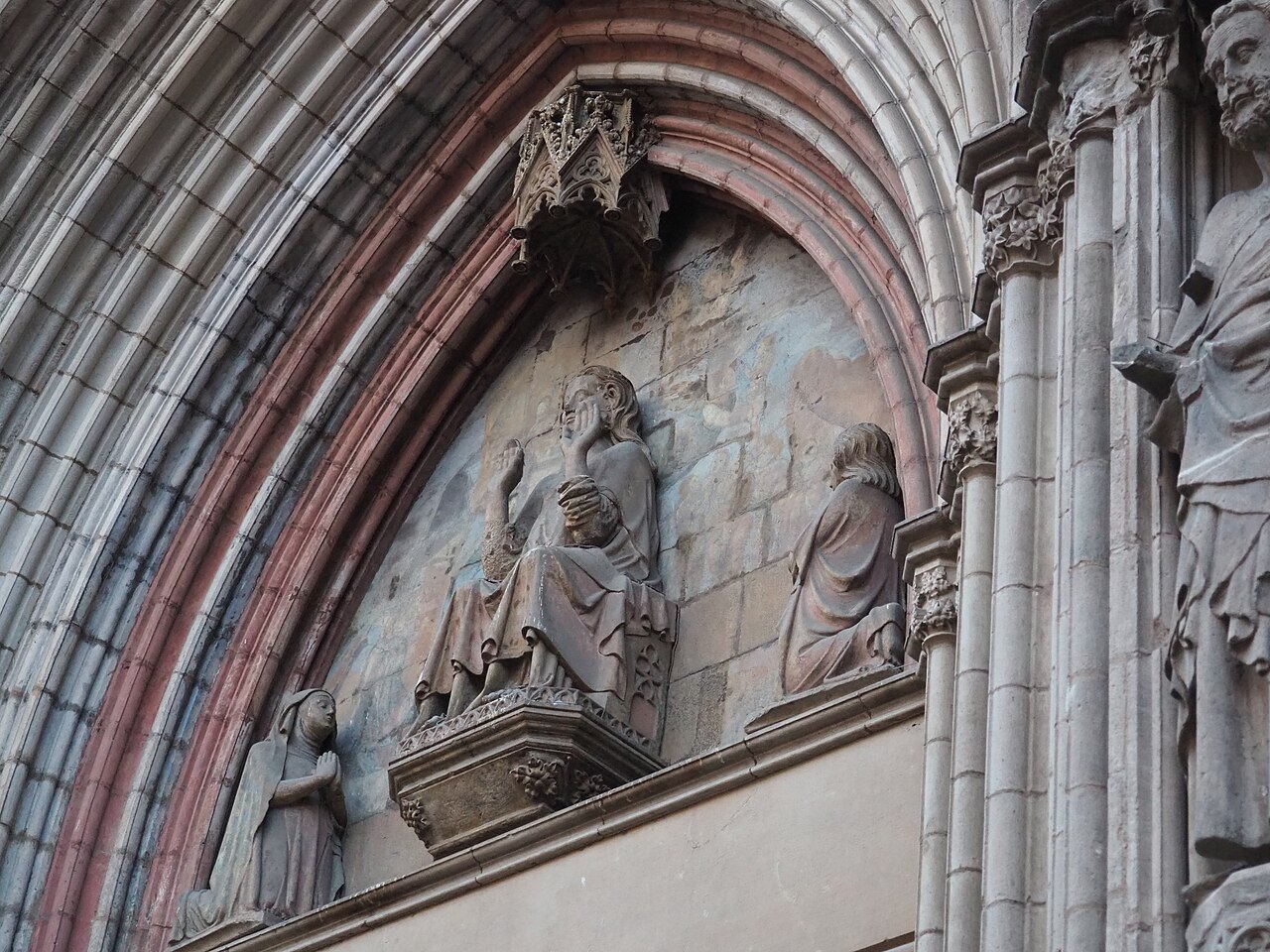
The Plaça de Santa Maria is dominated by the west end with its rose window. Images of Saint Peter and Saint Paul occupy niches either side of the west door, and the tympanum shows the Savior flanked by Our Lady and Saint John. The northwest tower was completed in 1496, but its companion was not finished until 1902.
The interior
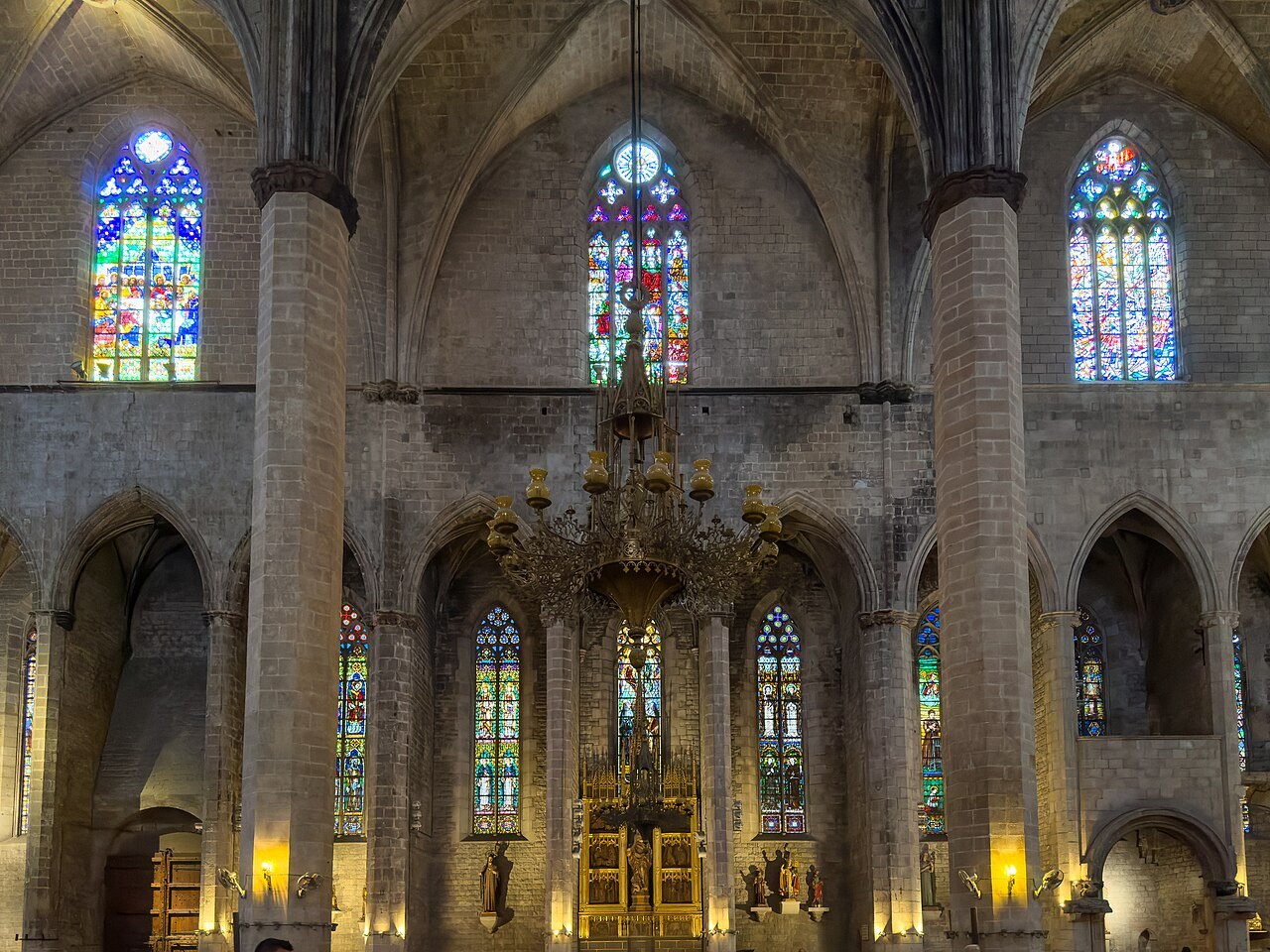
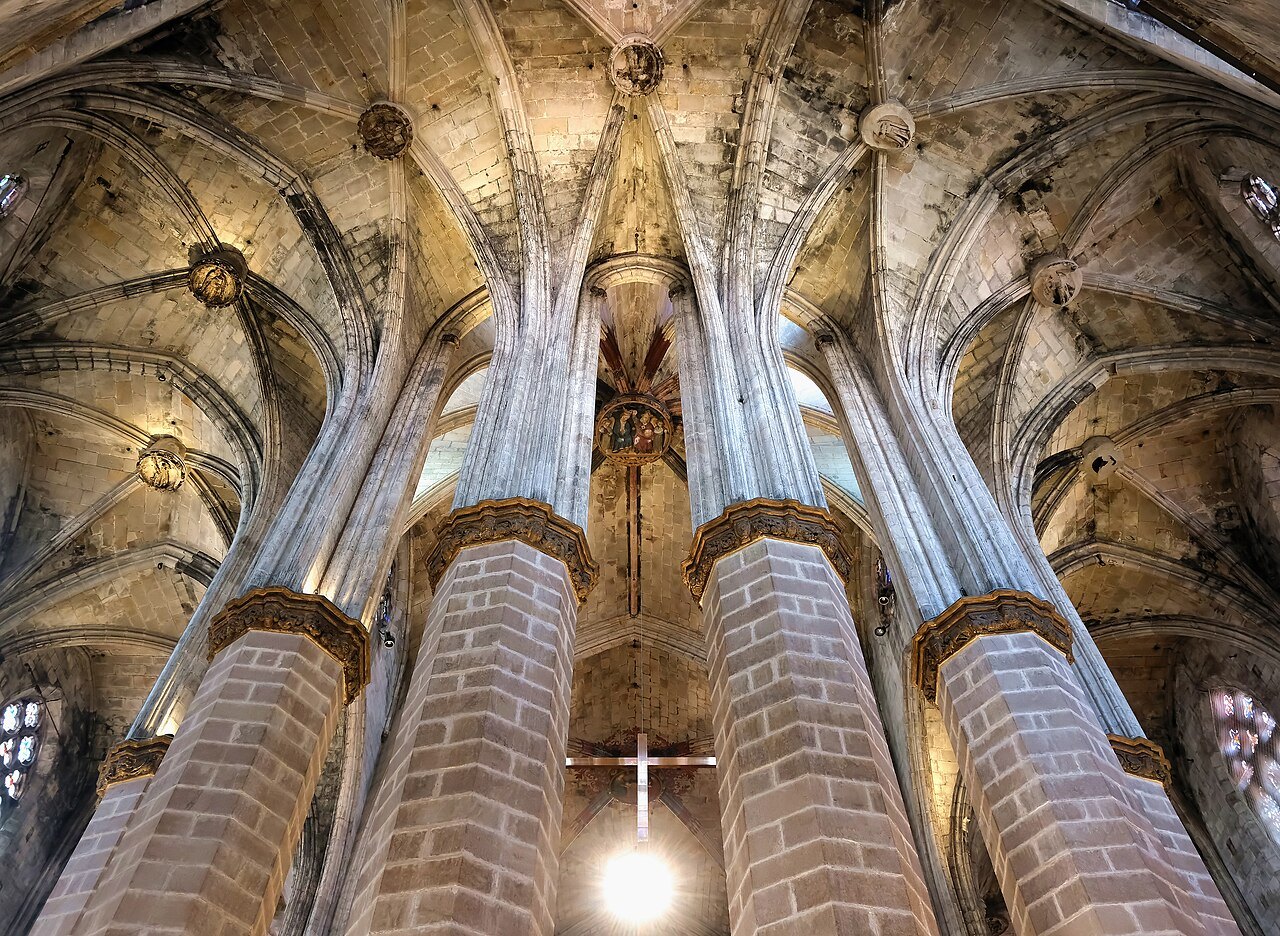
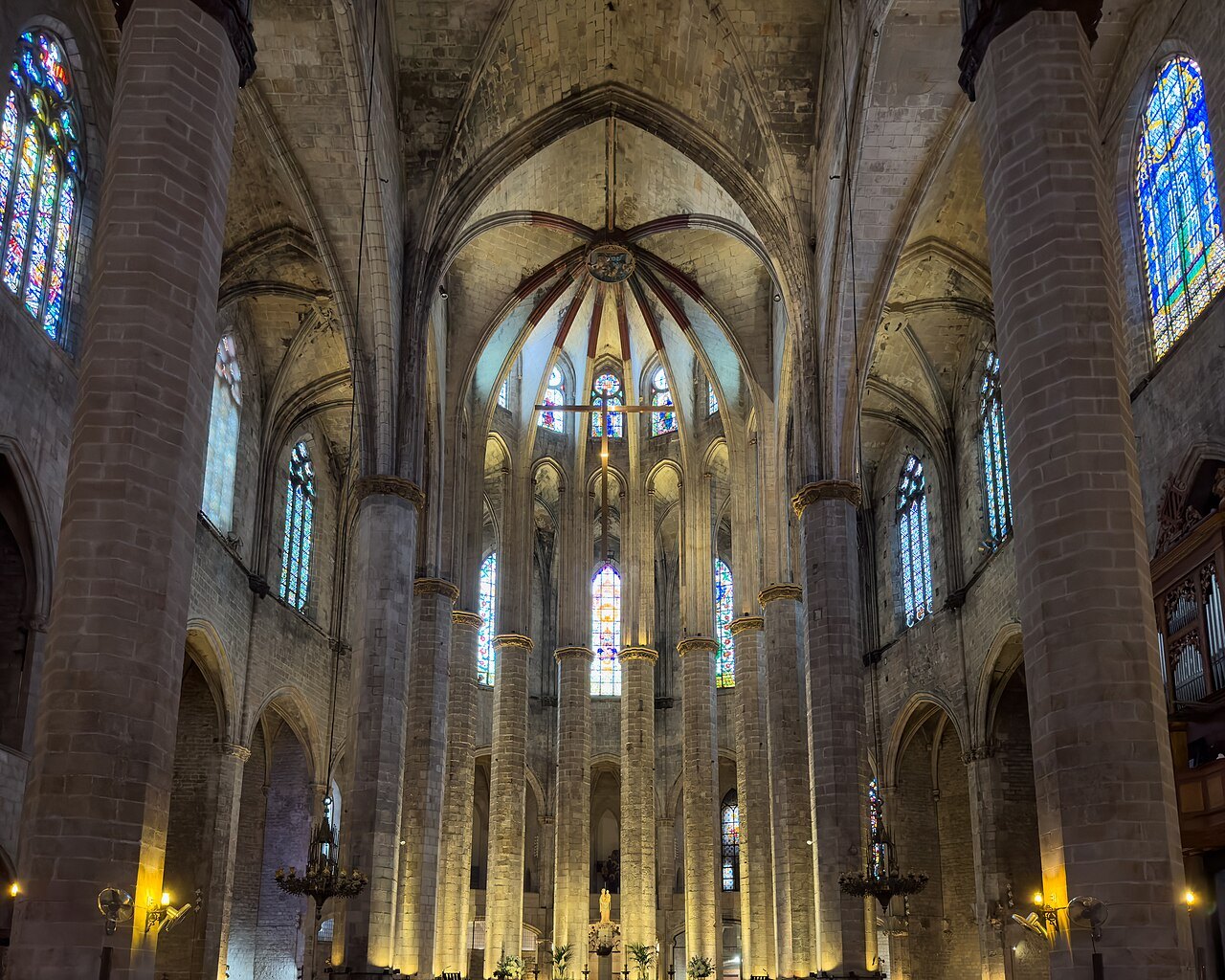
Inside, the impression is of light and spaciousness. The church is of the basilica type, its three aisles forming a single space, with no transepts and no architectural boundary between nave and presbytery. A simple ribbed vault is supported on slender octagonal columns, and abundant daylight streams in through tall clerestory windows.
The spacing of the columns is the widest of any Gothic church in Europe, about forty-three feet center to center. Compared with the cathedral and Santa Maria del Pi, the interior is almost bare of imagery, because of what happened in 1936.
Proportions in feet
According to the art historian Josep Bracons, the basic unit used in Santa Maria del Mar was the medieval foot of thirty-three centimeters. Measured that way, the side chapels are ten feet deep, the side aisles twice that, and the central aisle four times as wide, forty feet. The total width of the church is therefore one hundred medieval feet, which is also equal to the maximum height of the building.
That simple mathematical clarity is part of why the church feels so calm. Nothing is crammed in; the structure is the decoration.
Earthquake and fire
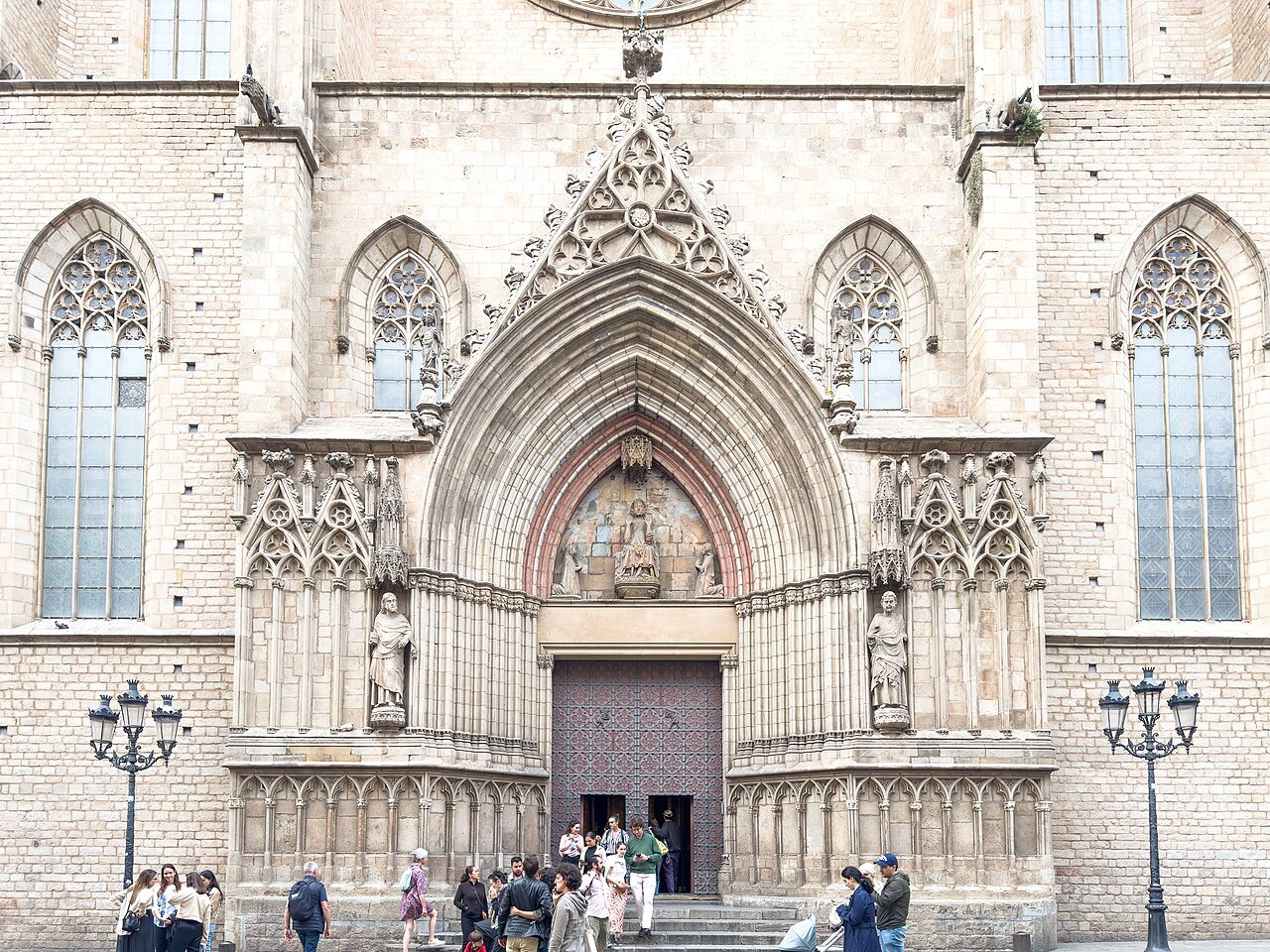
The 1428 Catalonia earthquake caused several casualties and destroyed the rose window at the west end. A new window, in the Flamboyant style, was finished by 1459 and glass was added the following year. The chapel of the Blessed Sacrament beside the apse was added in the nineteenth century.
Much of the church's decorative richness, its images and its Baroque altar, were destroyed in a fire set by anticlerical rioters at the start of the Spanish Civil War in 1936. The church burned for eleven days and survived. Among the most notable works lost was the Baroque retable by Deodat Casanoves and Salvador Gurri.
Repair by subscription
Renovations after the fire began in 1938, but the damaged windows were not replaced until the 1960s. Funds were low, so a fundraising campaign was started, and the football club was asked to contribute. It agreed on one condition: that its coat of arms appear on one of the stained-glass windows.
Some interesting stained-glass windows have survived from various periods, so the glass in the church ranges across the centuries.
Where it sits in the Born
Santa Maria del Mar is in La Ribera, the district that grew outside the Roman walls as a medieval merchant and maritime hub. Its narrow alleyways are full of small shops and bars, and the church is the quarter's anchor.
Go around the apse to the Fossar de les Moreres, a burial ground beside the church, before you go in. Then compare the calm of this nave with the cathedral's: the cathedral was built by the church and the crown, while this one was built by the neighborhood.
Catalan Gothic, the regional style
Santa Maria del Mar belongs to Catalan Gothic, a style confined to the Barcelona area and its influences. It seeks airy, diaphanous spaces and large spanning naves, and it does not aim to build towering heights but to balance the dimensions of the structure.
That balance is visible here more clearly than in any other church in the city: the wide aisles, the slender columns and the plain walls let the space itself carry the effect. The proportions, measured in whole medieval feet, are the reason, and the plain walls do the rest.
Nearby
Where to go next
- Nearby · Ciutat VellaThe Gothic QuarterThe Gothic Quarter, El Gòtic, is the historic center of Barcelona's old city, running from the Rambla to Via Laietana.Read the page →
- Nearby · Gothic QuarterBarcelona CathedralThe Cathedral of the Holy Cross and Saint Eulalia is the seat of the archbishop of Barcelona.Read the page →
- Nearby · Sant Pere · Ciutat VellaThe Palau de la Música CatalanaThe Palau de la Música Catalana is a concert hall designed by Lluís Domènech i Montaner and inaugurated on 9 February 1908 for the choral society Orfeó Català.Read the page →