Who was Josep Maria Jujol, and what did he make at Park Güell?
THE COLLABORATOR BEHIND THE BENCH
Who Josep Maria Jujol was, and why his curving mosaic bench defines the terrace at Park Güell.
Read on
The answer in full
Gaudí's collaborator
Josep Maria Jujol was a Catalan architect and designer who worked closely with Antoni Gaudí during the construction of Park Güell, built between 1900 and 1914. Among the park's many collaborators, he is remembered as Gaudí's gifted partner in decoration, credited with one of the site's most recognized features: the long, curving bench that wraps around the main terrace, along with its mosaic surface.
Unlike Gaudí, whose name appears across the park's signage and tickets, Jujol worked largely out of the spotlight. He is not credited with the park's overall design, its stone viaducts, or the Calvary at the summit; his signed contribution is the bench and its decoration, yet it remains one of the most photographed single structures in Barcelona, instantly recognized even by visitors who never learn his name.
Visitors wanting more on Jujol's life and other work should look for context in the permanent exhibit housed in one of the park's gatehouses, run by the Barcelona City History Museum, or ask at the park's information points; this guide can confirm his role at Park Güell but not a full account of his separate career across the city.
The bench on the terrace
The terrace at Park Güell sits above a forest of columns and is bordered by Jujol's bench, a long, curving structure shaped like a sea serpent that runs along the full edge of the platform. Its form is ergonomic, following the curve of a seated body, and the serpentine line breaks into alcoves that naturally separate groups of visitors while keeping them facing one another, a social idea built into ceramic.
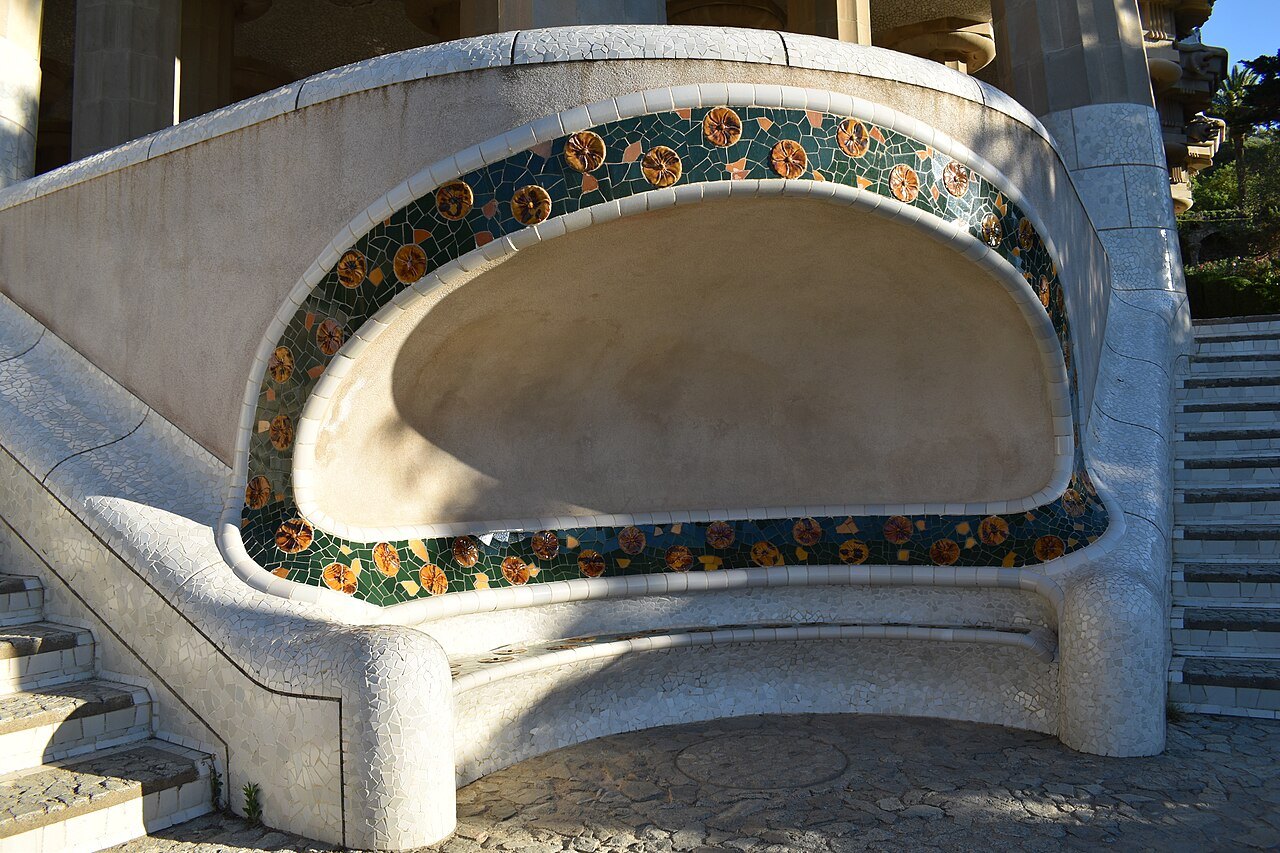
The bench's entire surface is covered in trencadís, broken ceramic tile pressed into the curved concrete in dense fields of color and fragment. Because the pieces are irregular offcuts rather than cut to measure, no two stretches of the bench repeat exactly, and the mosaic catches the light differently depending on the angle of the sun and the time of day spent walking its length.
The bench's curves also serve the park's wider purpose: the terrace above the columned hall was designed as common space, meant, along with the stairways and gardens, to carry ideals shared by Gaudí and his patron Eusebi Güell. Jujol's seating turns that ambition into something physical, a place built for conversation rather than passage, oriented so that groups face inward rather than out toward the view.
Trencadís, broken tile made fluid
Trencadís appears across Park Güell, most famously on the ceramic forms lining the stairway and on the colorful lizard near the entrance, where photographers often queue for a turn. Jujol's work on the terrace bench is considered among the finest uses of the technique in the whole site, since the bench's continuously curved surface let the broken tile follow a flowing line that flat walls do not allow.
The technique depends on reusing broken or offcut tile rather than cutting fresh pieces to a pattern, fixed onto a curved surface so the fragments follow the form underneath rather than a flat grid. At Park Güell this grew directly out of Gaudí's preference for curved, organic lines, the hallmark of what is called his naturalist period, the first decade of the 1900s.
During these years Gaudí's study of nature pushed his structural solutions toward geometry rather than classical ornament, a shift that also shaped the inverted catenary arches of the park's stone viaducts. Jujol's mosaic sits inside that same logic: decoration that grows out of structure and material rather than being applied afterward as a separate layer of ornament laid over a finished wall.
What the bench sits on
The terrace and its bench rest on a vaulted hall of columns below, built to double as part of the park's drainage: rain channels through the paving and down through the columns into a cistern system beneath. The ceiling of that hall carries its own mosaic, recalling the grotesque motifs of Roman wall painting, in particular the Domus Aurea in Rome.
That reference places Jujol's decorative work inside a wider classical vocabulary rather than treating it as pure invention; the grotto motifs below echo the same instinct that shaped the mosaic above, turning both floor and bench into continuations of one decorative scheme rather than separate projects handled by separate hands working apart from each other.
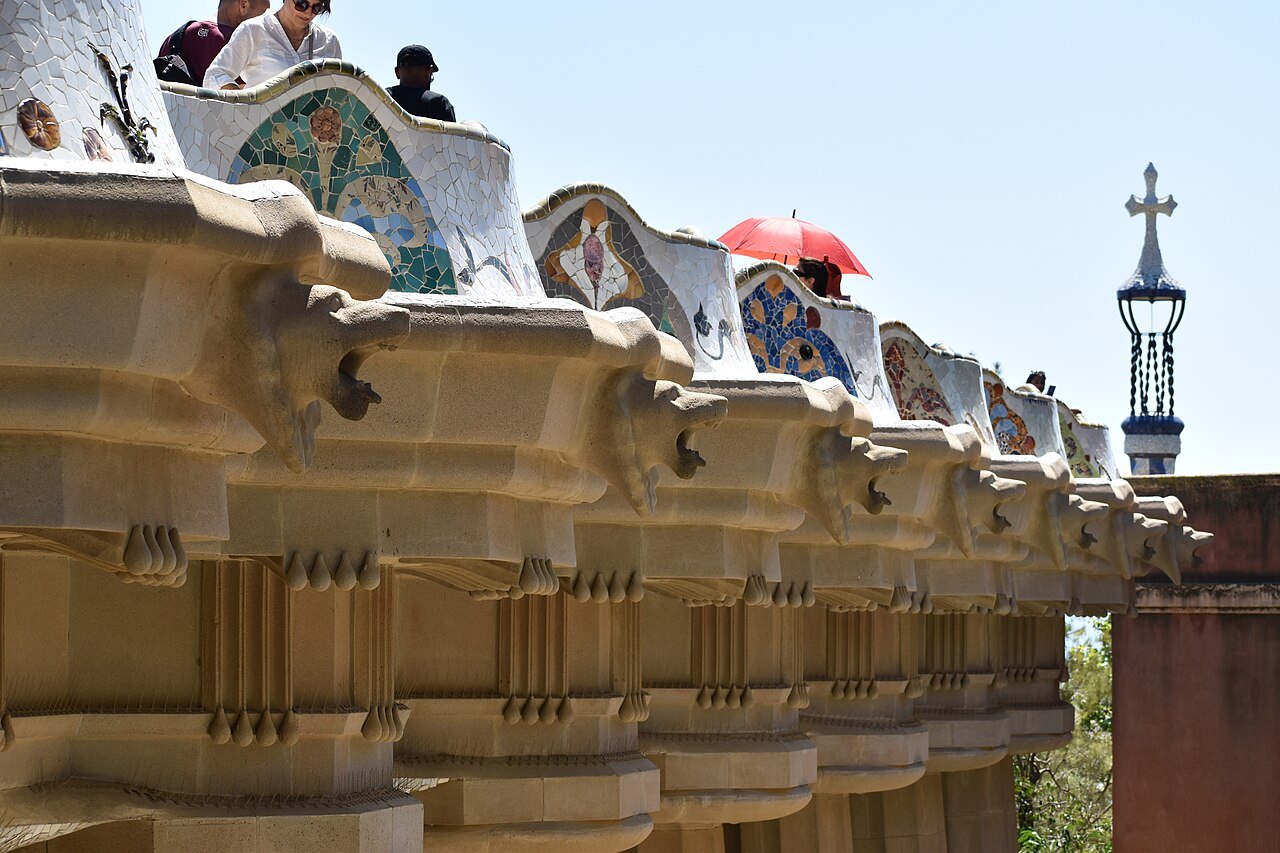
Seen together, the hall of columns and the terrace above show two registers of a single project: Gaudí's engineering, which used geometry to make a roof that drains water as well as carries a public plaza, and Jujol's surface, which turned that plaza's edge into one long, continuous artwork. Visitors curious about the structure should look at the columns first, then climb to the terrace.
Jujol and Gaudí elsewhere
Jujol's work for Gaudí was not limited to Park Güell. Collaboration of this kind, an architect setting the structure and a specialist shaping its surface, runs through other buildings credited to Gaudí in the city, including Casa Batlló and Casa Milà, where comparable ironwork and tile decoration were executed by craftsmen whose names rarely appear beside the architect's.
This division of labor is a useful way to read Modernisme more broadly: the architect supplied structure and concept, while specialist collaborators, often uncredited in their own lifetime, executed the ornament now recognized as some of the style's most distinctive features. Readers curious about the wider movement can find more context in this guide's overview of Modernisme.
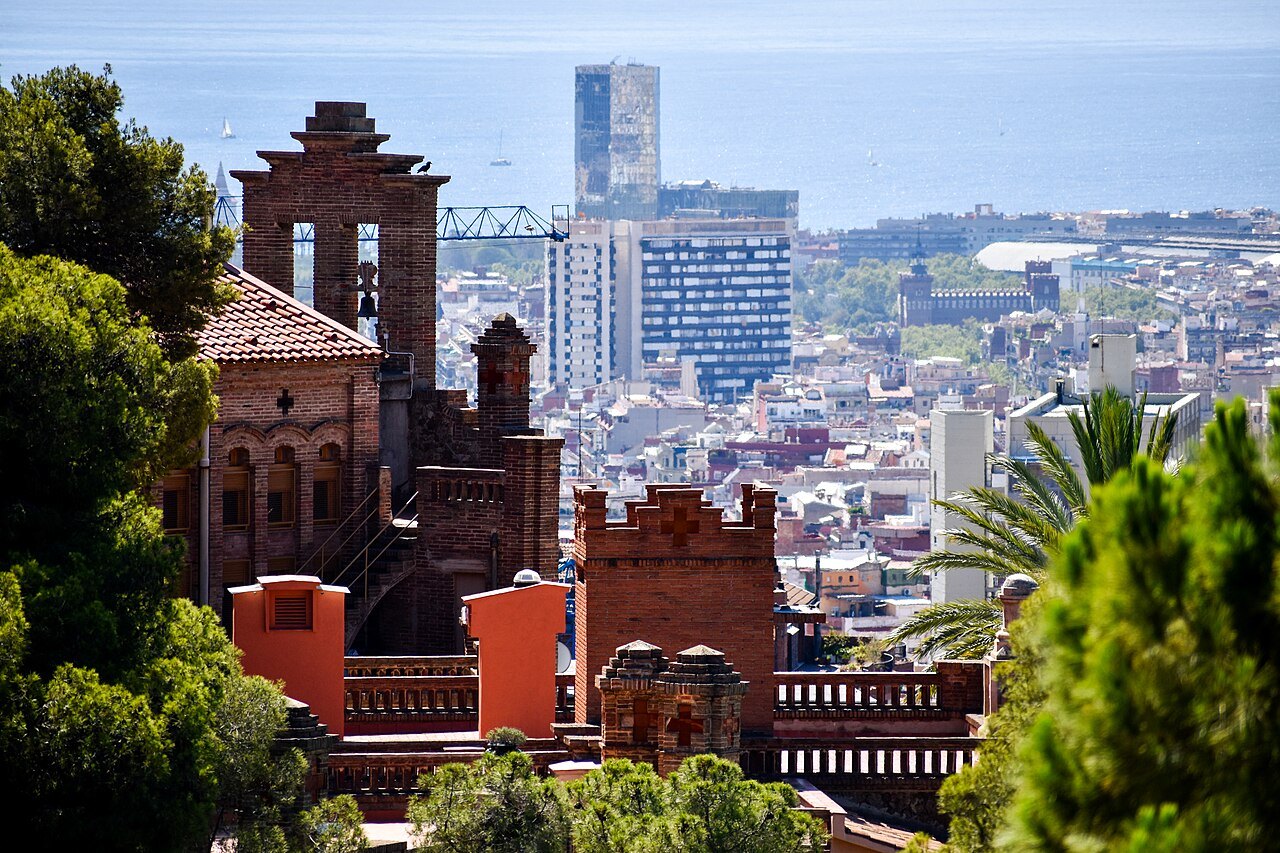
Gaudí also worked out some of the structural ideas used at Park Güell at the church of the Colònia Güell, outside the city, where he first developed the inverted catenary arches later reused in the park's stone viaducts; readers planning a visit beyond the center can read more among the day trips from Barcelona.
Seeing the bench today
The terrace and its bench lie inside the Monumental Zone of Park Güell, the ticketed area that also includes the main stairway, the mosaics and the viaduct gate. Entry has required a ticket since October 2013, and tickets can sell out, so check the park's official website well ahead rather than arrive without one; see this guide's advice on booking ahead for how far in advance to plan.
The nearest metro stations, Vallcarca and Lesseps, are not next to the entrance, and reaching the terrace means a further climb through the park once inside; check bus and metro options with the city's transport operator before setting out. Expect a steep approach in either case, since the site was chosen for its elevation above the city.
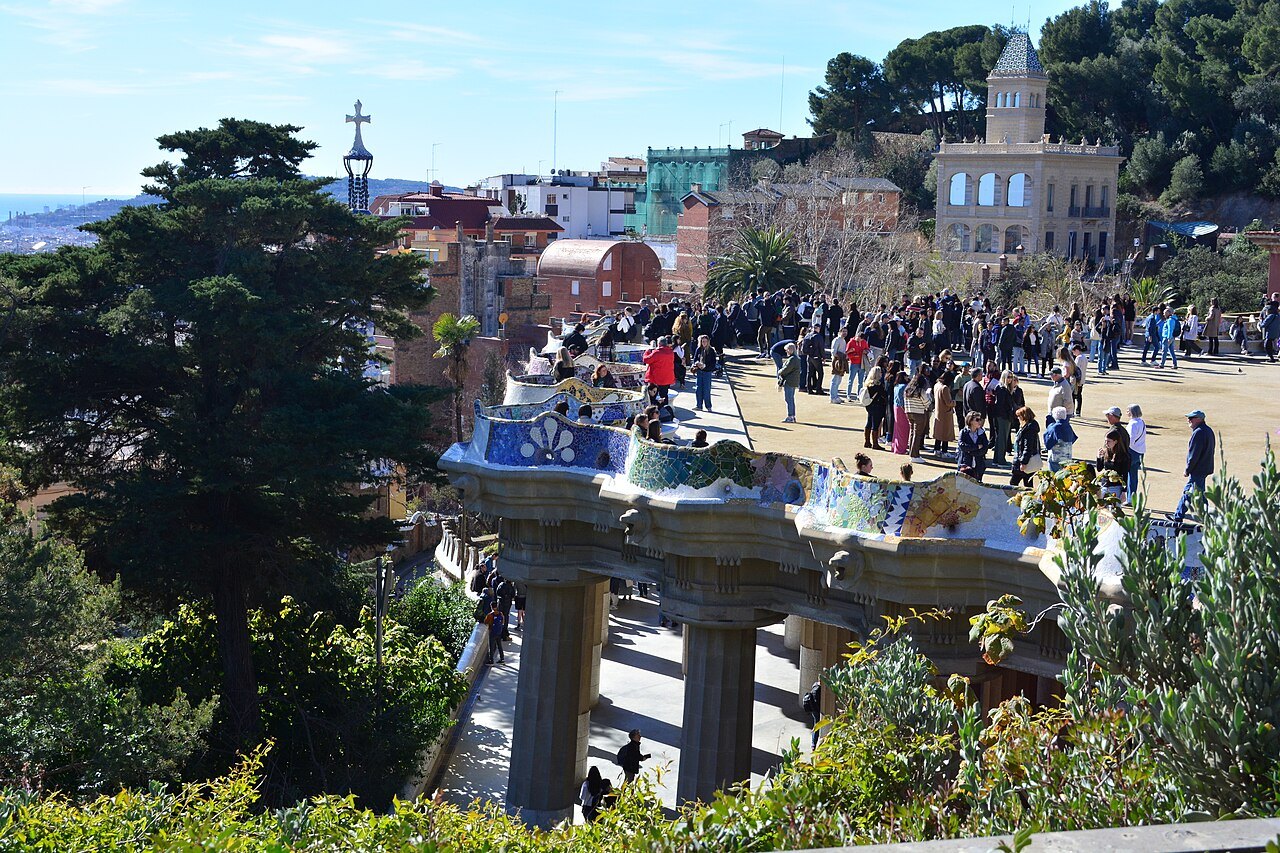
Once at the terrace, the bench rewards slow walking rather than a quick photograph: its alcoves are built for sitting and turning to face a companion, exactly as Jujol shaped them more than a century ago. The view from the terrace, taking in the Sagrada Família and the sea beyond, is best appreciated from one of those curved seats rather than standing at the rail.
More from the journal
Read next
- Park GüellHow did Gaudí design with hanging chains?Antoni Gaudí worked out the curves of his vaults by hanging weighted strings and chains and turning the result upside down. How the method worked, where it was first used and where to see it in Barcelona.Read the piece →
- The Sagrada FamíliaWho was Josep Maria Subirachs, and why are his figures so angular?How the sculptor Josep Maria Subirachs translated Gaudí's own 1917 drawings into the hard-edged Passion façade.Read the piece →
- Casa BatllóWhat is the Block of Discord?The Illa de la Discòrdia is a block on the Passeig de Gràcia where three Modernista masterpieces, by Domènech i Montaner, Puig i Cadafalch and Gaudí, stand side by side. How the rivalry began and what each house shows.Read the piece →